Homeschool Curriculum
Wonderpath’s teaching approach is student-centered, patient, and responsive. Instruction begins by noticing each child’s strengths, learning patterns, interests, and areas of challenge. From there, lessons are designed to create steady progress without overwhelming the student.
We emphasizes encouragement, consistency, and practical skill-building so students can develop both academic understanding and confidence in their ability to learn. Lessons are designed to feel safe, engaging, and purposeful, allowing children to take risks, ask questions, and experience success.
Our approach also recognizes that parents need support. Through planning, communication, and thoughtful guidance, Wonderpath Education helps the whole family.
Curriculum by Grade Level
-
In kindergarten, young children learn through imitation, movement, and meaningful activity. At this stage, they need their life-force energy to support the healthy development of their bodies, organs, and brains.
Children are closely observing the adults around them, exploring their world, and learning through imaginative play and imitation.
The rhythm of the day is supported through songs, poems, stories, movement, and playful engagement.
Fairy tales and simple stories are shared with warmth and imagination, often using simple props to bring the stories to life.
As children become ready to move from the dreamy world of early childhood into more organized learning, they shift from learning primarily through doing to learning through feeling, imagination, and curiosity.
-
In first grade, children begin to sense the interconnectedness of the world. New concepts are introduced through an experience of the whole before moving gradually into the details. This approach is known as teaching from the whole to the parts.
Language Arts
Learning is introduced playfully through bean bags, clapping, marching, singing, and movement.
The alphabet is introduced through storytelling, often using fairy tales and folk tales.
Nature stories support language development and deepen children’s connection to the natural world.
Indigenous stories are included with care and respect as part of a rich storytelling curriculum.
Students begin reading simple, developmentally appropriate texts.
Writing
Students practice uppercase and lowercase letters.
Writing develops through stories, sentences, poems, and descriptive captions.
Children learn to write by copying words, titles, and captions for illustrations, gradually building toward simple sentences.
Students learn to read through writing first, creating main lesson books that integrate language, art, and imagination.
Social Studies
Seasonal festivals help children experience community, rhythm, and cultural traditions.
Multicultural folk tales broaden students’ understanding of the world and nurture respect for diverse traditions.
Science
Science begins with nature walks, careful observation, and direct experience of the living world.
Students develop nature journals through sketching, noticing patterns, and recording seasonal changes.
Stories and nature study cultivate awe, wonder, and reverence for the natural world.
Math
Students explore the qualities of numbers through story, rhythm, movement, and hands-on experience.
All four mathematical processes—addition, subtraction, multiplication, and division—are introduced in a lively and imaginative way.
Mental math is practiced through rhythmic activities, oral work, and movement games.
Sacred geometry and form drawing support spatial awareness, balance, and pattern recognition.
Form drawing and early geometry help students experience line, shape, symmetry, and movement.
Handwork
Knitting supports focus, coordination, perseverance, and practical skill development.
Sewing introduces fine-motor skills, care, patience, and purposeful handwork.
Seasonal crafts connect students to the rhythms of the year and encourage creativity.
Spanish Language
Spanish is introduced through games, stories, songs, and playful repetition.
Students learn vocabulary for colors, animals, numbers, and everyday classroom life.
Basic greetings and simple phrases are practiced through speaking, singing, and movement.
Latin American cultural traditions are shared through stories, songs, celebrations, and seasonal activities.
Visual Arts
Wet-on-wet watercolor painting encourages color exploration, imagination, and sensitivity to the artistic process.
Beeswax modeling strengthens fine-motor development while inviting creative, tactile expression.
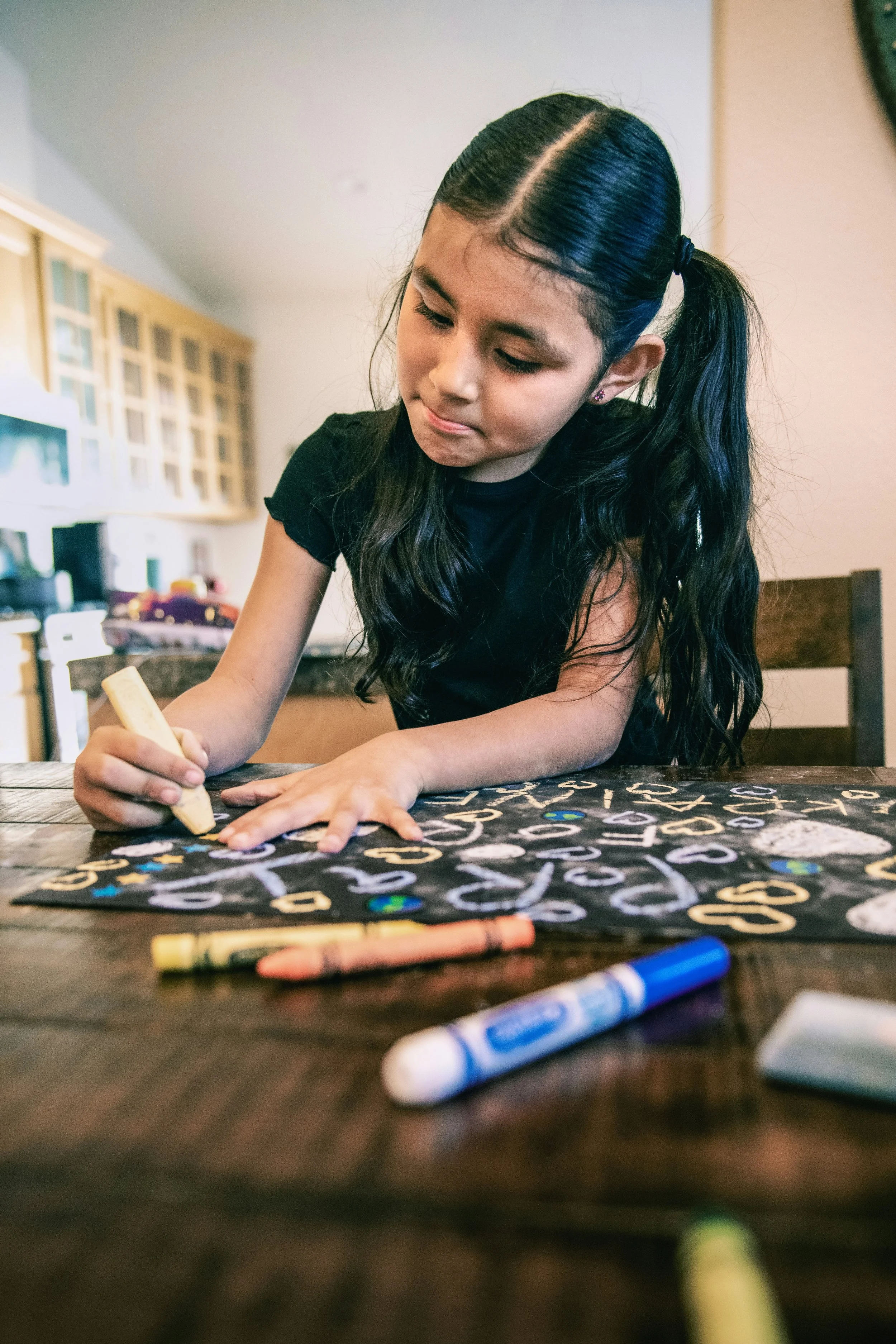
Crayon drawing supports storytelling, observation, and artistic confidence.
-
Our fourth grade program invites students into a lively rhythm of story, movement, observation, skill-building, and creative expression. Each class is designed to nurture curiosity, confidence, and a love of learning.
Monday, Wednesday, and Thursday Class Rhythm
5:00 –5:15 p.m. — Welcome students, check on completed work, and settle into the evening together.
5:15–5:30 p.m. — Begin with journal writing inspired by thoughtful prompts that encourage reflection and imagination.
5:30–6:00 p.m. — Explore literature through books, poems, and stories that spark conversation and wonder.
6:00–6:15 p.m. — Respond to literature in journals, making personal connections and practicing clear expression.
6:15–7:00 p.m. — Build math understanding through concepts, story-based learning, and meaningful practice.
Curriculum Highlights
Language Arts
Journey into Norse mythology through rich stories, archetypes, and imagination
Strengthen writing skills with regular practice, including cursive work with fountain pens
Build confidence and presence through poetry recitation
Tenses and syntax and comparative adjectives
Handwriting
Punctuation
Paragraphing
Independent compositions
Research reports
Social Studies
Celebrate festivals as meaningful markers of the seasons and community life
Explore Nordic culture through stories, traditions, and historical connections
Discover California geography and history with attention to place and people
Learn about Native American practical life with respect, observation, and hands-on context
Create maps that help students see relationships between land, culture, and movement
Science
Study zoology through the relationship between human beings and animals
Take nature walks that invite careful observation and a sense of wonder
Develop nature journaling and sketching as tools for attention, memory, and expression
Explore herbs and aromatherapy through sensory experience and practical learning
Math
Deepen understanding of fractions through visual, practical, and story-based work
Practice multi-digit long multiplication and division with steady skill-building and confidence
Work with mixed numbers
French/Spanish if we want Spanish
Practice Spanish through lively read-alouds and repeated listening
Build everyday vocabulary, including counting, time, seasons, and directions
Explore Spanish and Mexican influences through culture, language, and geography
Sacred Geometry
Practice form drawing and additional geometry to strengthen focus, rhythm, and spatial awareness
Weaving patterns and Celtic knots into drawing
Observe plants through spatial drawing, connecting geometry with the living world
Arts
Wet-on-wet watercolor painting
Clay modeling
Crayon and colored pencil drawing
Handwork
Cross-stitch and embroidery
Knitting
Sewing
Seasonal crafts
Theatre
Reenact stories through movement, dialogue, and imaginative play
Prepare and perform a class play
Music
Practice recorder skills through melody, rhythm, and breath
Sing rounds and choral music to build listening, harmony, and group confidence
Learning begins in wonder, grows through imagination, and becomes wisdom through experience.
Start With a Simple Consultation
Let’s begin with a brief consultation to discuss goals, schedule, learning needs, and the best-fit support option for your child.